Neck Pain and Sleep: Pillows, Positions, and the Pain Cycle
This is one of the most underrated topics in neck care, and one of the most useful. Sleep and neck pain are tied together in both directions: a sore neck wrecks your sleep, and poor sleep makes your neck more painful. If you only ever address one without the other, you tend to stay stuck. Get both right, and recovery accelerates.
Pain and sleep influence each other, and the research suggests the path from poor sleep to next-day pain is at least as important as the reverse.[1] In one year-long study of pain-free adults, low sleep quality was one of the factors that actually predicted who went on to develop neck pain, while phone posture did not.[2] That makes sleep one of the most useful levers you have, not a soft add-on.
Why a Sore Neck Ruins Sleep, and Vice Versa
When your neck hurts, finding a comfortable position is hard, you wake more often, and you spend less time in the deep, restorative stages of sleep. That part is obvious. The less obvious half is the return trip: when you are short on quality sleep, your nervous system becomes more sensitive to pain, your tolerance drops, and the same neck feels worse the next day.[1] Add the fatigue, stress, and shallow breathing that come with bad nights, and you have a self-reinforcing loop.
Choosing a Pillow That Supports Your Neck
The single job of a pillow is to keep your neck in a neutral position, in line with the rest of your spine, so the muscles and joints can switch off and rest. A pillow that is too high or too low can hold the neck at an angle for hours, which is one reason people wake up stiff. There is no single magic pillow. The right one depends on your size and how you sleep, but the principle of comfortable, neutral support is what matters.[3][4]
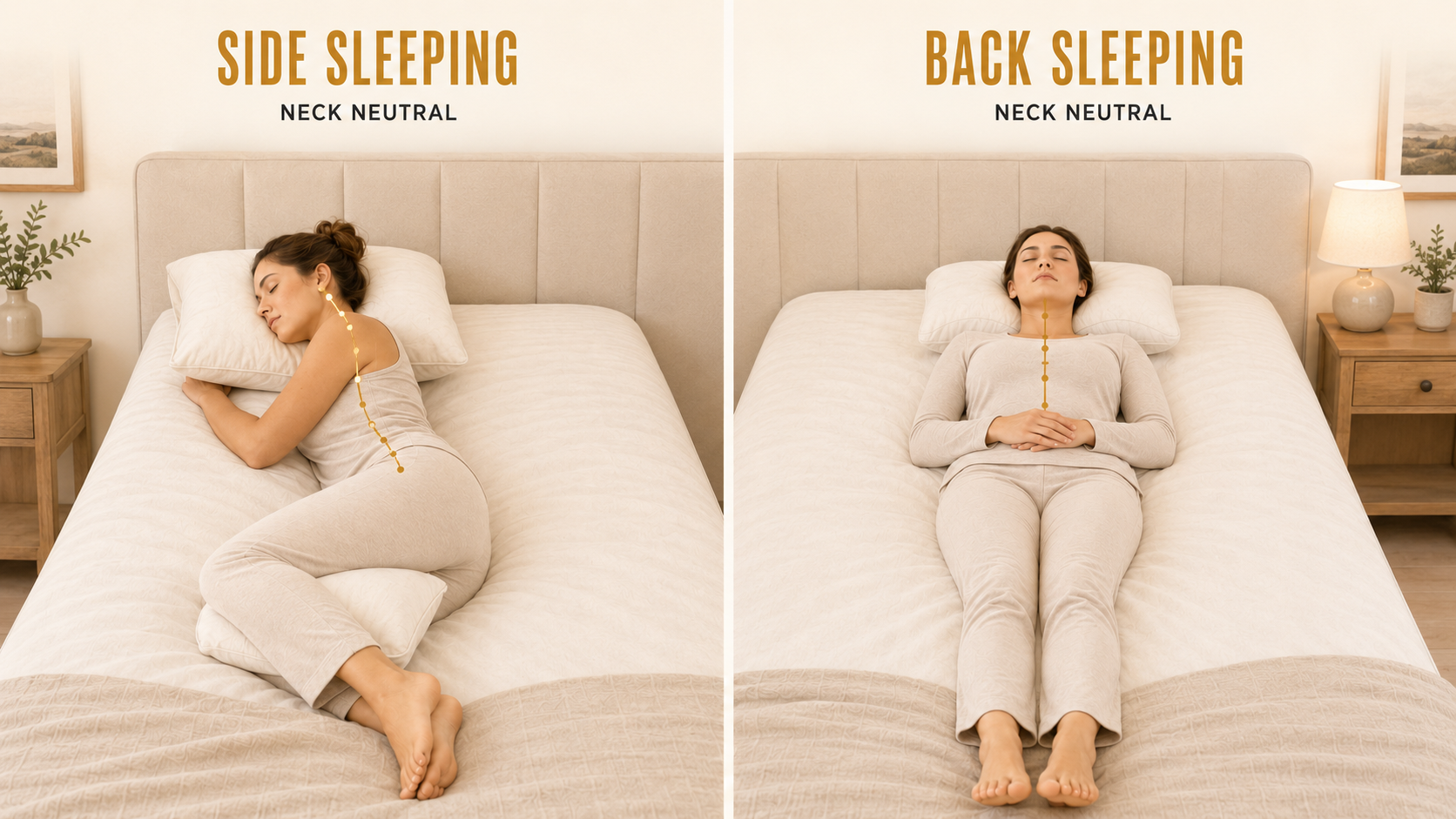
- For side sleepers: you need a higher, firmer pillow to fill the gap between your ear and the mattress, keeping your head level with your spine rather than dropping toward the bed or being propped up toward the ceiling.
- For back sleepers: a lower, contoured pillow that supports the natural curve of the neck without pushing your head forward.
- Material is secondary to height and support. Memory foam, latex, or a quality contour pillow can all work, the fit is what counts.
Lie down in your usual sleeping position and have someone look at you from the side, or check in a mirror. Your nose, chin, and the centre of your chest should be roughly in line, with the neck neither bent down toward the mattress nor cranked up toward the ceiling. If your head is propped at an angle, your pillow height is off. This simple check beats any marketing claim on the packaging.
The Best and Worst Sleeping Positions
Most people move through several positions a night, which is normal and healthy.[5] Still, where you spend the most time matters for an irritable neck.
Back and side: the neck-friendly options
Back sleeping keeps the neck naturally neutral with the right low pillow. Side sleeping is also good, provided the pillow height fills the shoulder gap and keeps your head level. Both let the neck rest in a balanced position.
Stomach: the position to move away from
Stomach sleeping is usually the toughest on the neck, because it tends to keep your head turned to one side for long periods so you can breathe. That sustained rotation is exactly the kind of prolonged end-range load an irritated neck does not tolerate well. If you are a dedicated stomach sleeper, transitioning toward your side is one of the higher-value changes you can make, even if it takes a few weeks to adjust.
Most neck pain at night is mechanical and position-related. But pain that has certain features deserves a prompt assessment rather than a new pillow:
- Night pain that is severe, unremitting, and not eased by any change of position
- Pain that consistently wakes you and is getting progressively worse
- Night pain accompanied by fever, unexplained weight loss, or feeling generally unwell
These patterns are uncommon, but they are worth checking promptly.
Breaking the Pain-Sleep Cycle
Because the loop runs both ways, you can break in from either side, and the best results come from doing both at once.[1][6]
- Fix the mechanics of the bed. Right pillow height for your position, and a shift away from stomach sleeping. This unloads the neck for the hours you cannot consciously control it.
- Protect your sleep quality. Consistent sleep and wake times, a wind-down routine, and limiting late screens all improve the sleep that, in turn, lowers your pain sensitivity. This is genuinely part of neck treatment, not separate from it.
- Keep treating the neck itself. Hands-on care, medical acupuncture, and especially progressive strengthening make the neck more comfortable and resilient, so it disturbs your sleep less. See the neck mobilization and stability program.
- Address stress and breathing. The same bracing and chest breathing that load the neck by day also make it harder to settle at night. Relaxed diaphragmatic breathing helps on both counts.
If you regularly wake with a stiff, painful neck despite getting the pillow and position right, that is worth investigating. It often points to an underlying driver, mechanical neck pain, spondylosis, or stubborn trigger points, that responds well to targeted care.
If you have been hunting for the perfect pillow for years, widen the lens. The pillow matters, but so does your overall sleep quality, your stress, and the strength of your neck. Treating sleep as a core part of neck care, rather than an afterthought, is often the missing piece.
When neck pain and poor sleep are feeding each other, treating both together is what breaks the cycle. A focused assessment gets you a clear plan and better nights. Call the clinic at 647-560-4495.
Book an Assessment at ONE80References
All references link directly to PubMed. Tap a citation number in the article to jump here. Tap the arrow beside a reference to return to where you were reading.
- Finan PH, Goodin BR, Smith MT. The association of sleep and pain: an update and a path forward. J Pain. 2013;14(12):1539-1552. pubmed.ncbi.nlm.nih.gov/24290442 ↩
- Correia IMT, et al. Cervical flexion posture during smartphone use was not a risk factor for neck pain, but low sleep quality and insufficient physical activity were: a 12-month longitudinal investigation. Braz J Phys Ther. 2025;29(6):101258. pubmed.ncbi.nlm.nih.gov/40845624 ↩
- Pang JCY, Tsang SMH, Fu ACL. The effects of pillow designs on neck pain, waking symptoms, neck disability, sleep quality and spinal alignment in adults: a systematic review and meta-analysis. Clin Biomech. 2021;85:105353. pubmed.ncbi.nlm.nih.gov/33895703 ↩
- Gordon SJ, Grimmer-Somers K. Your pillow may not guarantee a good night's sleep or symptom-free waking. Physiother Can. 2011;63(2):183-190. pubmed.ncbi.nlm.nih.gov/22379258 ↩
- Skarpsno ES, et al. Sleep positions and nocturnal body movements based on free-living accelerometer recordings. Nat Sci Sleep. 2017;9:267-275. pubmed.ncbi.nlm.nih.gov/29138608 ↩
- Gross A, et al. Exercises for mechanical neck disorders. Cochrane Database Syst Rev. 2015;1:CD004250. pubmed.ncbi.nlm.nih.gov/25629215 ↩