Cervical Radiculopathy: When Neck Pain Travels Down the Arm
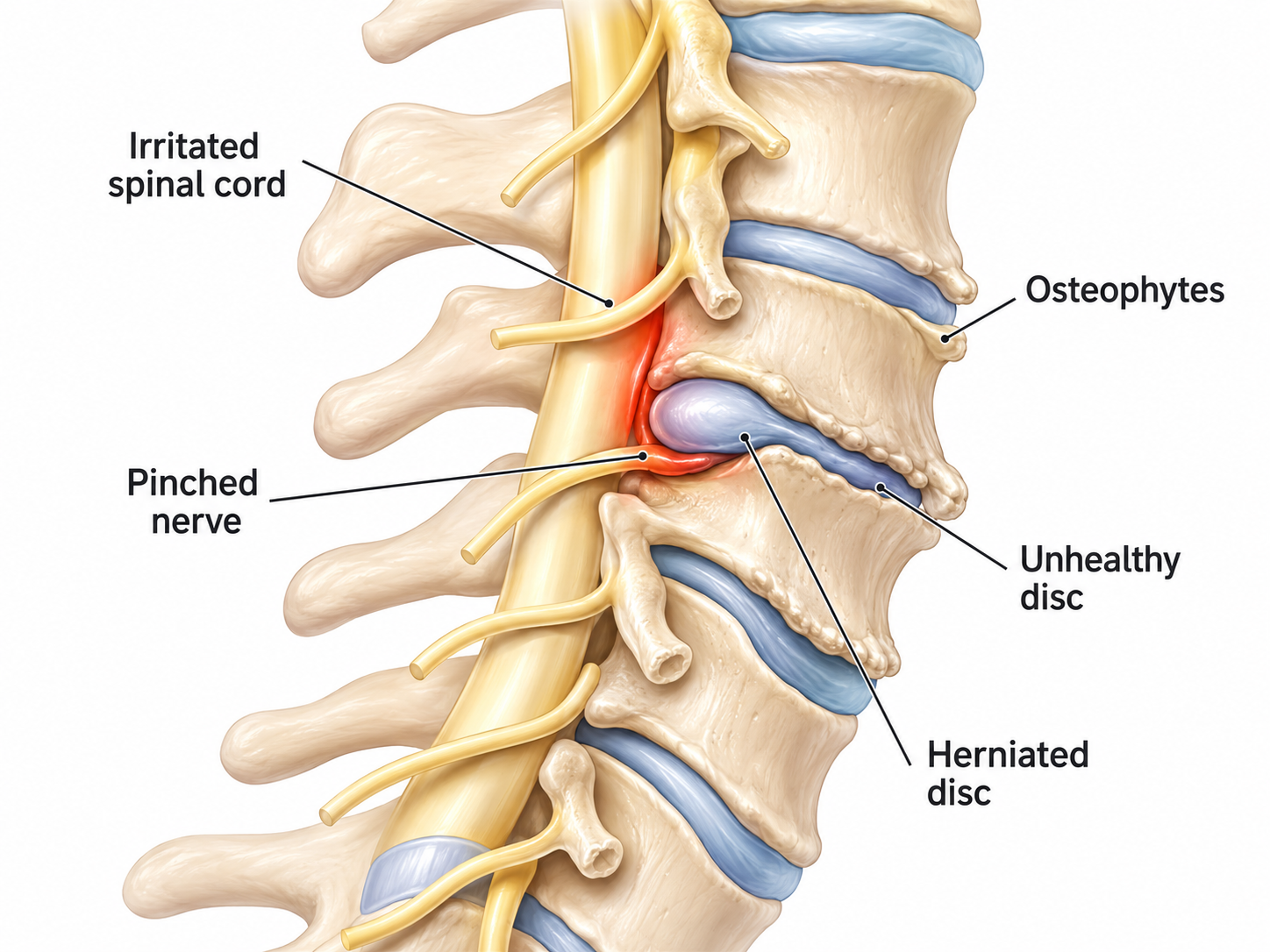
Cervical radiculopathy is what happens when the root of a nerve is compressed or irritated as it exits the spinal cord in the neck. Because that nerve travels down into the arm, the symptoms travel too: numbness, pins and needles, and sometimes weakness in the part of the arm and hand that the nerve supplies, usually alongside neck pain. The two most common causes are cervical spondylosis and a disc problem, though some less common conditions can produce it as well.[1]
This is the type of neck pain that tends to worry people the most, because arm symptoms feel different and more dramatic than a stiff neck. So let me start with the reassuring part.
The natural course of cervical radiculopathy is generally favorable. Most people improve substantially with conservative care, and surgery is avoidable for the majority.[2][6] Much of the improvement tends to happen in the first few months, and the large majority of people settle over time.[3][4] Recovery can be slower than a simple stiff neck, which tests patience, but the direction of travel is usually toward better.
Why a Neck Problem Causes Arm Symptoms
Each level of the neck sends out a pair of nerve roots, and each root carries sensation and power to a specific territory of the shoulder, arm, and hand. When a root is irritated, whether by an arthritic narrowing or a disc pressing on it, the brain experiences the symptoms along that whole territory, not just at the neck. That is why a problem at the level of the spine can show up as tingling in two fingers, or weakness when you try to lift or grip.
The Symptoms
- Pain, numbness, or pins and needles that travel down the arm, often in a specific band rather than the whole arm.
- Neck pain that may be aggravated by certain neck positions, and sometimes eased by raising the arm overhead.
- Weakness or a sense of clumsiness in particular movements of the arm or hand. This is the feature that sets radiculopathy apart from ordinary mechanical neck pain.
- Symptoms that flare with fatigue or stress, as with many neck conditions.
Mechanical neck pain can refer mild, short-lived symptoms toward the arm, but it should not produce progressive neurological loss. Persistent numbness or tingling, symptoms that follow a clear nerve-root pattern, or any loss of strength or coordination suggests a nerve root may be involved and warrants a prompt, careful assessment.
Most radiculopathy is managed conservatively, but some features need prompt or urgent attention:
- Significant or progressing weakness in the arm or hand
- Severe arm pain with major neurological deficits right from the time of an injury
- Symptoms that are clearly and steadily worsening
- Any clumsiness of the hands, walking unsteadiness, or bowel or bladder changes, which point beyond a single nerve root and need urgent assessment
If severe symptoms follow a significant injury, treat it as an emergency.
How Is It Diagnosed?
A thorough history and physical examination is the foundation. Specific provocation and relief tests can help support the diagnosis and rule in or out other explanations. Imaging such as MRI is reserved for cases with significant or progressive neurological signs, a history of trauma, persistent symptoms, or any red flags, rather than ordered routinely.[1][2]
How Is It Treated?
Because the natural course is favorable, the first-line approach is conservative, and it works well for most people.[2][5][6]
- Staying active and reassured. Education, continued daily activity, and an early structured home exercise plan are the backbone. Prolonged rest and collars are generally unhelpful.
- Targeted exercise. Movement to reduce nerve sensitivity and restore tolerance, then progressive strengthening once symptoms allow. See the neck mobilization and stability program.
- Hands-on care. Carefully selected mobilization, soft tissue and fascial techniques, and medical acupuncture can reduce pain and improve tolerance, with technique chosen to suit an irritable nerve.
- Medical co-management when needed. For persistent or severe cases, options such as medication or injections can be discussed with your physician.
- Surgical consultation, occasionally. Reserved for significant or progressive weakness, or pain that does not respond to a fair trial of conservative care. It is the exception, not the rule.
Return to a professional if the pain worsens, if it persists beyond a few weeks, or if weakness, numbness, or tingling in the arm or hand increases.
To drive, cycle, or ride a motorcycle safely, you must be able to turn your head quickly. Avoid driving until you can check blind spots safely and your arm symptoms do not affect steering, grip, reaction time, or control. Take particular care if you have any arm weakness.
Cervical radiculopathy often responds well to conservative care, and most people avoid surgery. A careful assessment confirms what is happening and starts the right plan. Call the clinic at 647-560-4495.
Book an Assessment at ONE80References
All references link directly to PubMed. Tap a citation number in the article to jump here. Tap the arrow beside a reference to return to where you were reading.
- Iyer S, Kim HJ. Cervical radiculopathy. Curr Rev Musculoskelet Med. 2016;9(3):272-280. pubmed.ncbi.nlm.nih.gov/27250042 ↩
- Childress MA, Becker BA. Nonoperative management of cervical radiculopathy. Am Fam Physician. 2016;93(9):746-754. pubmed.ncbi.nlm.nih.gov/27175952 ↩
- Wong JJ, et al. The course and prognostic factors of symptomatic cervical disc herniation with radiculopathy: a systematic review. Spine J. 2014;14(8):1781-1789. pubmed.ncbi.nlm.nih.gov/24614255 ↩
- Sleijser-Koehorst MLS, et al. Clinical course and prognostic models for conservatively managed cervical radiculopathy: prospective cohort. Eur Spine J. 2018;27(11):2710-2719. pubmed.ncbi.nlm.nih.gov/30327908 ↩
- Kuijper B, et al. Cervical collar or physiotherapy versus wait and see for recent onset cervical radiculopathy: RCT. BMJ. 2009;339:b3883. pubmed.ncbi.nlm.nih.gov/19812130 ↩
- Thoomes EJ, et al. The effectiveness of conservative treatment for patients with cervical radiculopathy: a systematic review. Clin J Pain. 2013;29(12):1073-1086. pubmed.ncbi.nlm.nih.gov/23446070 ↩