Why Is Neck Pain Such a Pain in the Neck?
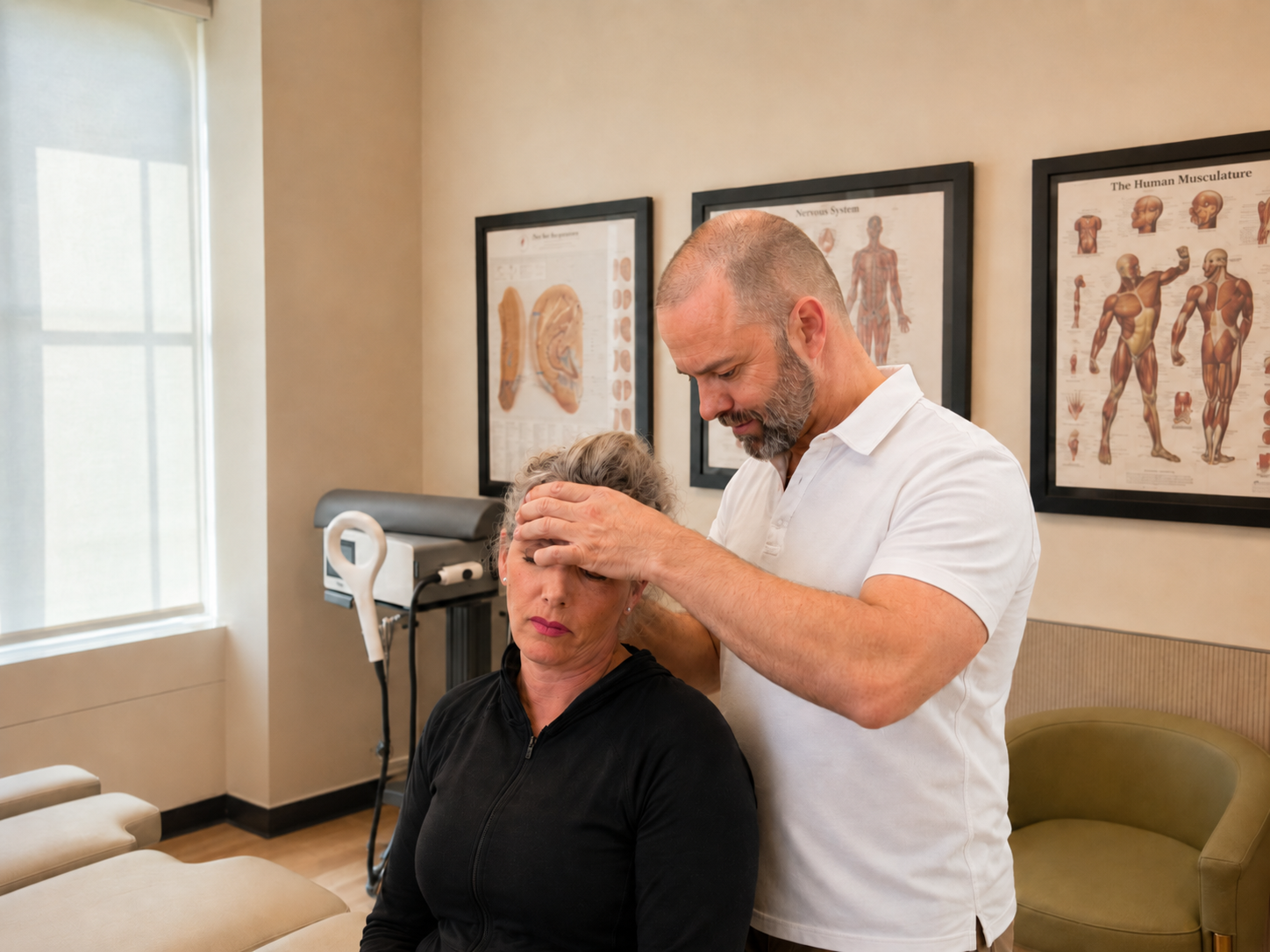
Neck pain has a way of taking over everything. It can be a quiet stiffness that nags at the end of a long day, or it can be the kind of sharp, guarding pain that stops you from checking your blind spot, sleeping on your side, or turning to talk to the person beside you. In some cases it stays local. In others it travels, spreading into the base of the skull, across the shoulders, or down an arm into the hand.
In many cases, there is an earlier sensitizing event or repeated exposure that sets the stage, although it is not always dramatic. Sometimes it is obvious, like a car accident, a fall, or a sport impact. Other times it is the slow accumulation of sustained positions, low movement variability, stress-related bracing, and a workstation that quietly loads the same tissues day after day. Over time, the demand on the tissue can exceed what the neck is currently prepared to tolerate. Then you turn your head quickly, get jostled, or reach awkwardly in the gym, and the neck finally complains. Once that first episode happens, neck pain can become recurrent unless the underlying capacity, movement, and recovery pieces are addressed.
How Common Is Neck Pain, Really?
Very common. Neck pain is one of the leading causes of years lived with disability worldwide, and the numbers have been climbing for decades.[1][2] More than half of all people will experience a meaningful bout of neck pain at some point in their lives.[3] In industrialized countries, a large share of working-age adults are dealing with some degree of neck pain at any given moment.
Here is the part that matters for you, though: common does not mean trivial, and it also does not mean dangerous. The overwhelming majority of neck pain is mechanical, which means it comes from the muscles, joints, ligaments, and discs doing their ordinary jobs under less-than-ideal conditions. Most mechanical problems respond well to mechanical and active solutions. That is good news.
Most neck pain is mechanical, not sinister. It is shaped by load, movement variability, stress, sleep, history, and capacity, and it usually responds well to movement, targeted strengthening, recovery strategies, and hands-on care. The job of a good assessment is to confirm that pattern and catch the rare exceptions early.
What Actually Causes Neck Pain?
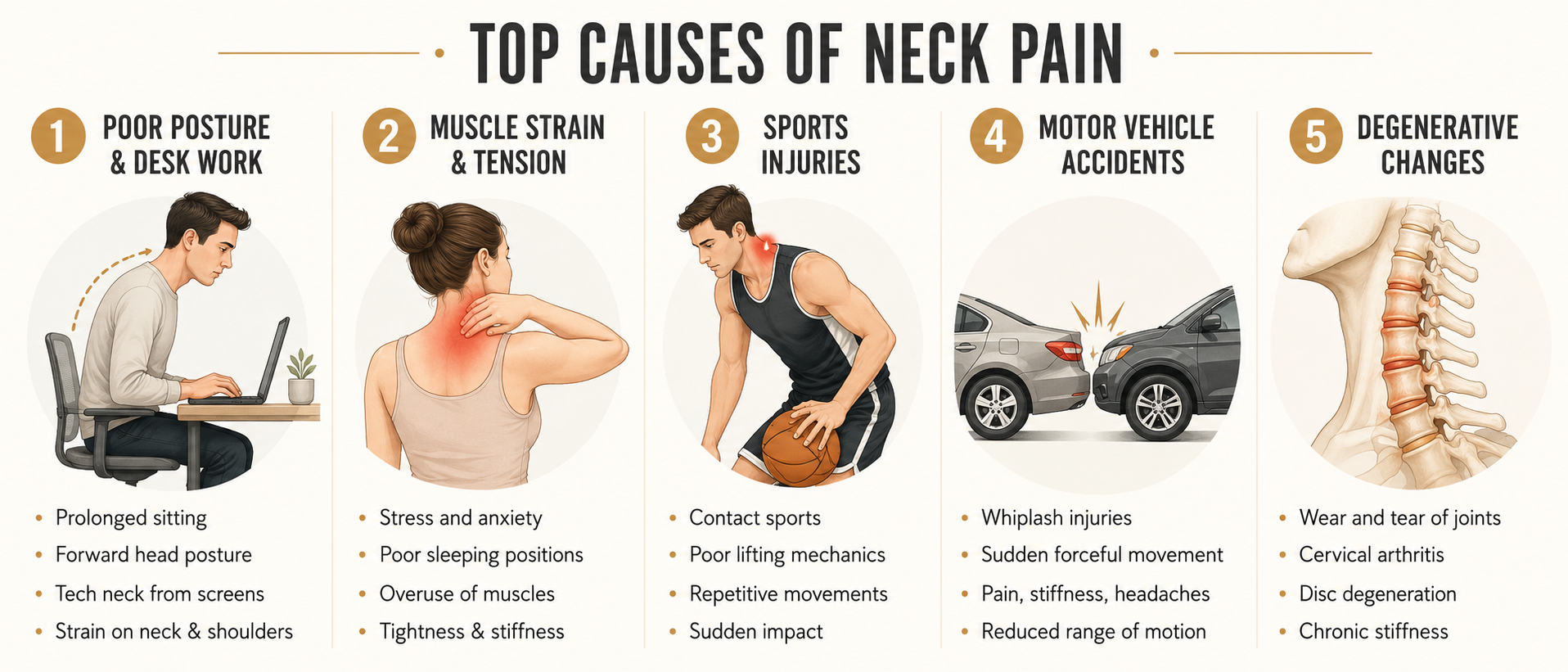
When someone asks me what causes neck pain, the honest answer is: it depends. It depends on the type of pain, the history, and whether there was a trigger. But the contributing factors tend to cluster into a handful of categories that show up again and again.
Load and capacity. Pain often appears when the demand on the tissue exceeds what the tissue is currently prepared to handle. That can happen because the load went up, because capacity went down, or both. Neck strength and endurance are protective, which is why deconditioning is such a reliable setup for recurrence.
Sustained positions and low movement variability. It is less about a single "correct" posture and more about how long you hold any one position. A neck held in the same place for hours, whatever that position is, can become irritable. The fix is usually variety and movement, not rigidity.
Stress and breathing. This is the one most people underestimate. Under stress, we tend to breathe higher into the chest, brace through the shoulders, and use the accessory breathing muscles of the neck more than necessary. That steady background load can keep an already irritated neck irritated.
Previous injury. An old whiplash, a previous disc episode, or a past fall can change how the tissue tolerates load, especially if strength, mobility, and confidence were never fully restored. It does not doom you, but it may mean the neck deserves a bit more attention and maintenance.
The Main Types of Neck Pain
Most neck pain is not the result of serious injury or disease, and it often improves well with the right plan. Still, it helps to know the main categories, because the type shapes the plan. Each of these has its own deeper article in this series.
Mechanical neck pain
The most common type, sometimes called simple or non-specific neck pain. It comes from irritation of the muscles, fascia, ligaments, and joints, and it is strongly tied to sustained load, low movement variability, stress, and deconditioning. It also tends to respond very well to the right active plan. Read the full article on mechanical neck pain.
Whiplash and Whiplash Associated Disorder (WAD)
Whiplash is an acceleration-deceleration injury to the neck. People assume it only happens in serious car accidents, but a slip on the ice, a hit in hockey or rugby, or even a minor-looking fall off a bike can do it. The front neck muscles can be involved, and restoring their control and strength is often central to recovery. Read the full article on whiplash and WAD.
Cervical spondylosis (the aging neck)
This is age-related wear of the vertebrae and discs, essentially osteoarthritis of the neck. It sounds alarming on an imaging report, but degenerative changes are extremely common and frequently painless. Keeping the neck mobile and strong is the priority. Read the full article on cervical spondylosis.
Cervical radiculopathy
This is when a nerve root in the neck is compressed or irritated, producing symptoms that travel down the arm: numbness, pins and needles, and sometimes weakness. The common causes are spondylosis and disc problems. The encouraging part is that the natural course is usually favorable. Read the full article on cervical radiculopathy.
Myofascial pain and trigger points
The "knots" people feel across the top of the shoulders and into the neck. These tender, taut bands are often described as trigger points. They can refer pain to the head and shoulder blade and are a frequent companion to all of the above. Read the full article on myofascial pain and trigger points.
Two more topics round out the series and deserve their own discussion because of how often they come up: what the evidence actually says about "tech neck" and posture, and the two-way relationship between neck pain and sleep.
More serious and far rarer causes do exist, including inflammatory arthritis, bone disorders, infection, cancer, and significant injury to the vertebrae, spinal cord, or nerves. These are uncommon, but they are exactly what a thorough assessment is designed to screen for.
The Symptoms, and What They Mean
The main features of ordinary mechanical neck pain are restricted movement and pain that can spread to the base of the skull or across the shoulders. Movement tends to feel guarded, and certain directions make it worse.
Pain that spreads down the arm comes from irritation of a nerve traveling from the neck. Mild pins and needles can occur with mechanical neck pain, but it is exactly that, mild, and it is not accompanied by true weakness. The distinction between mild referred symptoms and a clearer nerve-root pattern is one of the most useful things an assessment sorts out.
What Is the Outlook?
For most acute, sudden-onset neck pain, the outlook is good. Symptoms usually begin to settle within a few days, although the exact timeline varies from person to person and depends on history. As a rule of thumb, if things have not started to improve after a few days, it is worth having it looked at.
Some people develop chronic or recurrent neck pain, where the pain comes and goes and flares during periods of stress. Those flares are usually driven by sustained positions, deconditioning, stress, or load, not necessarily by something being structurally wrong. This is precisely the situation where an active rehabilitation approach pays off, because exercise and graded loading are among the best-supported treatments we have for neck pain.[5][6]
Some symptoms point to something beyond ordinary mechanical neck pain. Do not wait on these, have your neck assessed promptly:
- Pain that is progressively worsening regardless of what you do
- New numbness, tingling, weakness, or clumsiness in a hand or arm
- Feeling unwell with other symptoms such as unexplained weight loss or fever
- Distinct tenderness over the bones of the neck, especially after trauma
If you have severe symptoms after a significant injury, or any sign of spinal cord involvement, treat it as an emergency and go to the nearest emergency department.
What Actually Helps
The aim of care is simple to state: restore comfortable, confident movement, then build the capacity that helps keep it from coming back. In practice that means a combination of things working together, guided by current clinical guidelines for neck pain.[7][8]
- Movement and targeted exercise. The cornerstone. Mobility work to restore range, then progressive strengthening for the deep neck flexors and the muscles that stabilize the neck and upper back. This is what changes the long-term trajectory.
- Hands-on care. Joint manipulation or mobilization, soft tissue and fascial work, and medical acupuncture may help reduce pain and restore motion, especially early, creating a window to load and strengthen.
- Posture and workstation variety. Not a single rigid "perfect" posture, but more movement, more position changes, and a setup that does not lock you into one sustained load.
- Sleep and your pillow. A supportive pillow unloads a tired neck. Poor sleep amplifies pain, and pain wrecks sleep, so this is worth getting right.
- Stress and breathing. Restoring relaxed, diaphragmatic breathing takes the constant background load off the neck's accessory muscles.
- Medication, when appropriate. Best discussed with your physician or pharmacist for your specific situation.
Treatment should be revisited with a professional if the pain gets worse, if it persists beyond a few weeks, or if you develop numbness, weakness, pins and needles, or symptoms that travel into the arm or hand.
To drive, cycle, or ride a motorcycle safely, you need to be able to check blind spots quickly and comfortably. Avoid driving if your neck movement is too limited to do that safely, or if medication, dizziness, arm weakness, or pain affects your control. When in doubt, get assessed first.
If your neck pain is new, persistent, or keeps coming back, a thorough assessment helps clarify what type of neck pain you have and what is most likely to help. That is the fastest way out of the cycle. Call the clinic at 647-560-4495.
Book an Assessment at ONE80References
All references link directly to PubMed. Tap a citation number in the article to jump here. Tap the arrow beside a reference to return to where you were reading.
- Kazeminasab S, et al. Neck pain: global epidemiology, trends and risk factors. BMC Musculoskelet Disord. 2022;23:26. pubmed.ncbi.nlm.nih.gov/34980079 ↩
- Safiri S, et al. Global, regional, and national burden of neck pain in the general population, 1990-2017. BMJ. 2020;368:m791. pubmed.ncbi.nlm.nih.gov/32217608 ↩
- Fejer R, Kyvik KO, Hartvigsen J. The prevalence of neck pain in the world population: a systematic critical review. Eur Spine J. 2006;15(6):834-848. pubmed.ncbi.nlm.nih.gov/15999284 ↩
- Kjaer P, et al. GLA:D Back group-based patient education integrated with exercises to support self-management of back pain: development, theories and scientific evidence. BMC Musculoskelet Disord. 2018;19:418. pubmed.ncbi.nlm.nih.gov/30497440
- Gross A, et al. Exercises for mechanical neck disorders. Cochrane Database Syst Rev. 2015;1:CD004250. pubmed.ncbi.nlm.nih.gov/25629215 ↩
- Wilhelm MP, et al. The effects of exercise dosage on neck-related pain and disability: a systematic review with meta-analysis. J Orthop Sports Phys Ther. 2020;50(11):607-621. pubmed.ncbi.nlm.nih.gov/33131392 ↩
- Bier JD, et al. Clinical practice guideline for physical therapy assessment and treatment in patients with nonspecific neck pain. Phys Ther. 2018;98(3):162-171. pubmed.ncbi.nlm.nih.gov/29228289 ↩
- Cote P, Wong JJ, et al. Management of neck pain and associated disorders: a clinical practice guideline from the Ontario Protocol for Traffic Injury Management (OPTIMa) Collaboration. Eur Spine J. 2016;25(7):2000-2022. pubmed.ncbi.nlm.nih.gov/26984876 ↩