Frozen Shoulder: Stages, Timeline and What Actually Speeds Recovery

Frozen shoulder is one of the most misunderstood conditions in musculoskeletal medicine. For most of the last century it was called adhesive capsulitis, based on the assumption that the joint capsule develops adhesions that need to be broken up. Modern arthroscopic and histological research has shown that picture is wrong. There are no true adhesions.12
What is actually happening is more interesting, and the implications for treatment are significant. A recent international viewpoint argues for a fundamental shift in how we understand and manage frozen shoulder, moving from a narrow focus on the joint capsule to an integrated approach that addresses the whole person.3
Whether you are six weeks into a sudden loss of motion or two years into a shoulder that just will not return, this guide will help you understand what is going on, why a generic stretch sheet is not enough, and what good care actually looks like.
Beyond "Adhesive Capsulitis": What Frozen Shoulder Actually Is
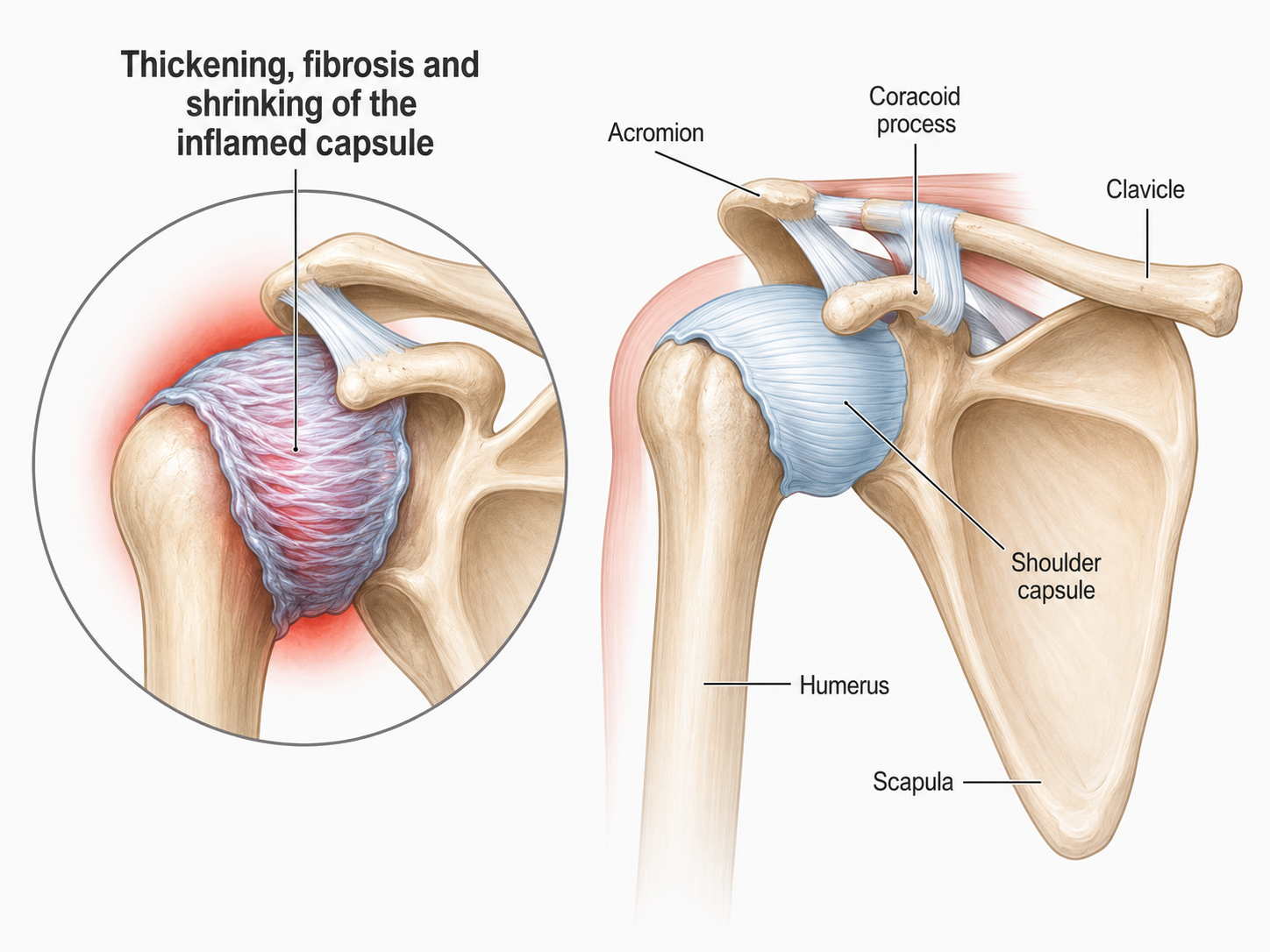
When researchers look inside a frozen shoulder, they do not find adhesive tissue. They find an active fibroproliferative process: a transformation of capsular tissue that, under the microscope, looks remarkably similar to Dupuytren's contracture in the hand. Fibroblasts shift into a smooth-muscle-like phenotype called myofibroblasts, laying down collagen and progressively contracting the capsule.14
A growing body of evidence reframes frozen shoulder as a musculoskeletal manifestation of a systemic immunometabolic state. Inflammatory cytokines (TNF-alpha, TGF-beta1, IL-6, IL-1beta), advanced glycation end-products that stiffen connective tissue, and metabolic markers like elevated HbA1c and cholesterol all show consistent associations with the condition.356
This reframing matters. It explains why frozen shoulder so often co-occurs with diabetes, thyroid dysfunction, lipid abnormalities, and the menopausal transition. It explains why some shoulders respond beautifully to local treatment while others persist for years. And it points toward a more complete approach to recovery than capsular stretching alone.
Who Gets Frozen Shoulder?
The pattern is consistent across populations. Frozen shoulder predominantly affects adults between 40 and 65, with a strong skew toward women, particularly during the perimenopausal and postmenopausal years. The condition affects roughly 2 to 5 percent of the general population.7
Other commonly associated conditions and exposures include:
- Type 2 diabetes and pre-diabetes
- Thyroid dysfunction, particularly hypothyroidism
- Dyslipidemia and elevated body mass index
- Cardiovascular and cerebrovascular disease
- Autoimmune conditions
- Recent shoulder surgery or extended immobilization
- Smoking history
The presence of one or more of these does not make the condition inevitable, but they do appear to lower the threshold for the inflammatory-to-fibrotic cascade to take hold.45
The Three Stages
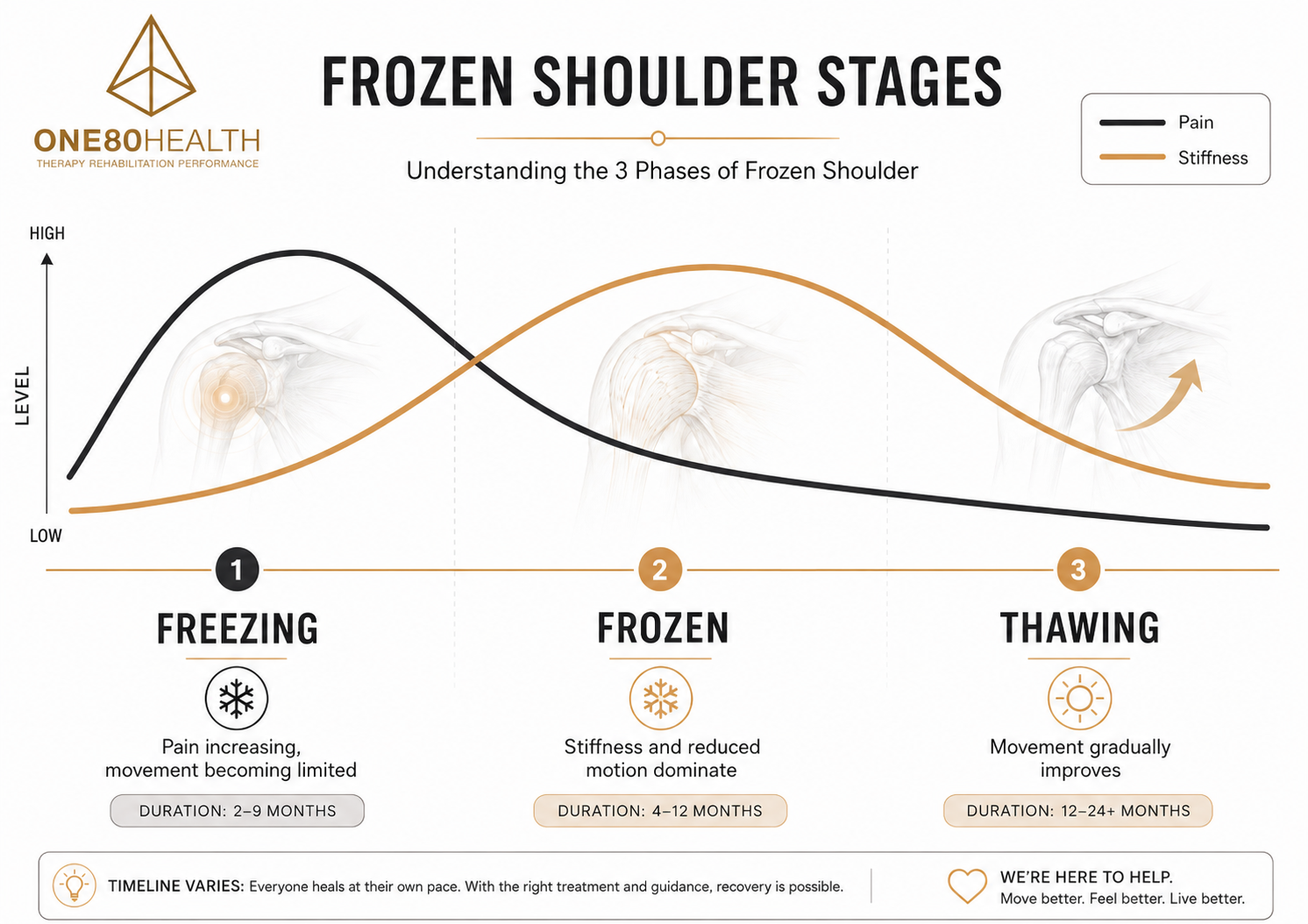
The classical staging framework still has clinical value, although the timelines are approximate and patients do not always move through them cleanly.
Freezing (6 weeks to 9 months)
Pain is the dominant feature. Range of motion starts to decline, although the loss may not be obvious yet. Sleep is often disrupted by a deep, aching quality that intensifies at night. Inflammation is biochemically active. The tissue is irritable, reactive, and easily flared.4
Frozen (4 to 12 months)
Pain often eases but stiffness becomes the main problem. External rotation is typically affected first and most severely, followed by abduction and internal rotation. Fibrosis dominates over inflammation. This is the stage at which most patients first walk into our office, wondering why their shoulder will not let them move.
Thawing (6 months to 2 years)
Range of motion gradually returns as tissue remodeling proceeds.
Why "Wait It Out" Is Not the Right Plan
The "self-limiting" idea, that frozen shoulder simply runs its course over two years and resolves on its own, is one of the most stubborn myths in this field. The evidence does not support it.
Long-term follow-up studies show that 27 to 50 percent of patients still have persistent pain, restricted motion, or both, up to a decade after onset.89
Watchful waiting is not a safe default. Active, staged management changes outcomes.3
Stage-Matched Treatment: What Actually Works
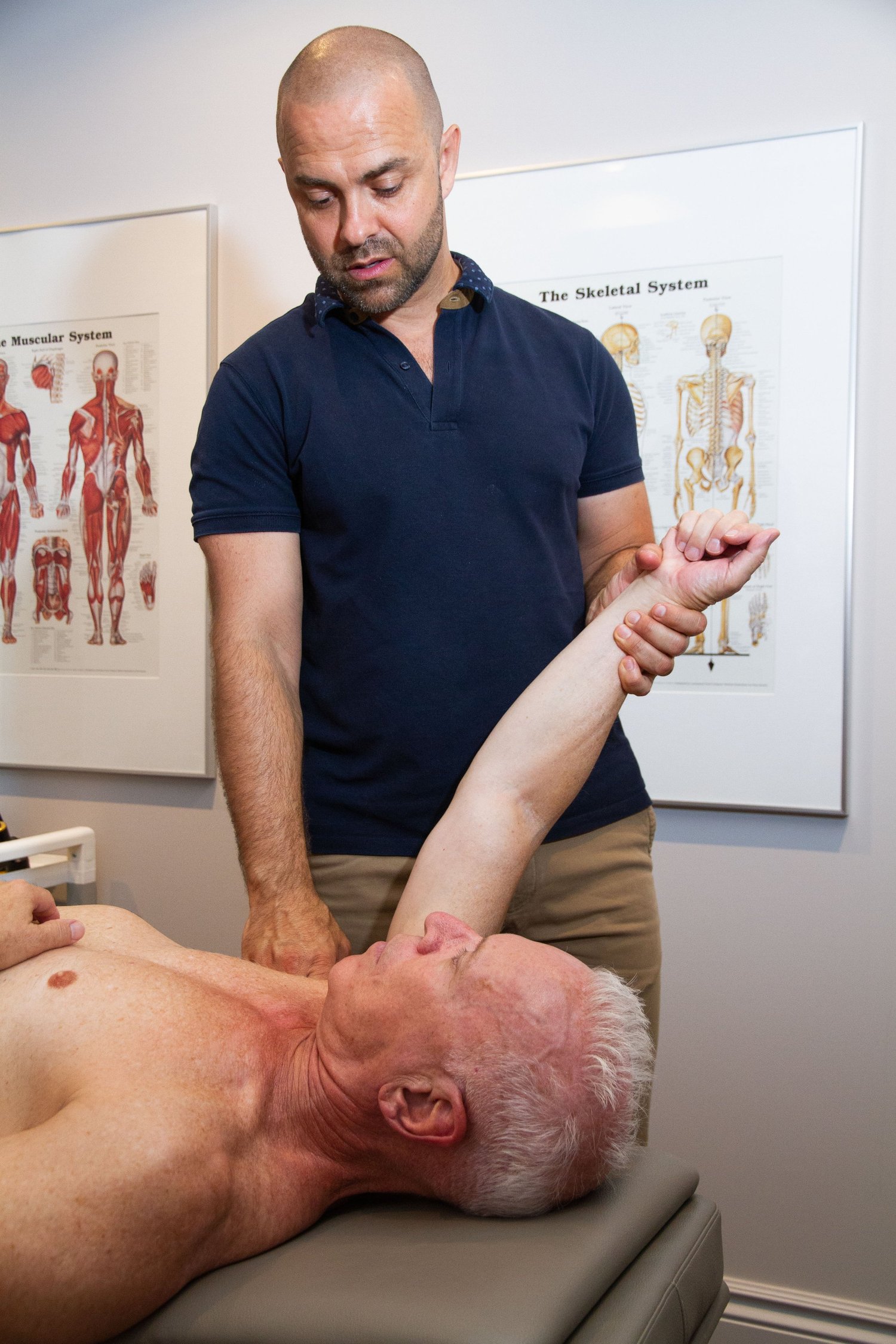
The most important clinical shift in modern frozen shoulder care is recognizing that what helps depends on where the condition is in its trajectory. The wrong intervention at the wrong time does not simply fail to help, it can actively prolong the problem.
We assess what clinicians call "irritability," meaning how reactive the tissue is, and match the approach accordingly.
High Irritability (Early Freezing)
The shoulder is hot, painful, and easily flared by even small loads. The clinical priority is to settle the system, not to push it.
- Gentle, pain-free passive range of motion
- Education about what is happening and what the path forward looks like, since fear of movement and pain catastrophizing are among the strongest psychological predictors of poor outcome
- Acupuncture and modalities for pain modulation10
- A targeted corticosteroid injection if pain is preventing sleep and engagement with care
- Sleep positioning strategies
Moderate Irritability (Late Freezing into Frozen Stage)
Pain has eased somewhat. Stiffness is the limiting factor. Treatment expands.
- Supervised exercise therapy with stretching, muscle energy techniques, and PNF patterns
- Manual therapy and joint mobilization performed at end range, at the right grade1112
- Mirror therapy in cases with significant pain or kinesiophobia
- Daily capsular stretching at home with sustained holds
- Hydrodilatation, a procedure where saline, local anesthetic, and corticosteroid are injected into the joint capsule under imaging guidance to gently expand it13
Low Irritability (Frozen and Thawing Stages)
The shoulder tolerates load. The work shifts to full progressive rehabilitation.
- Progressive loading of the rotator cuff and scapular stabilizers
- Activity-oriented training that mirrors real-world demands
- Full-arc mobility work
- Reintegration into sport, work, and daily life
The Systemic Side: What Most Programs Miss
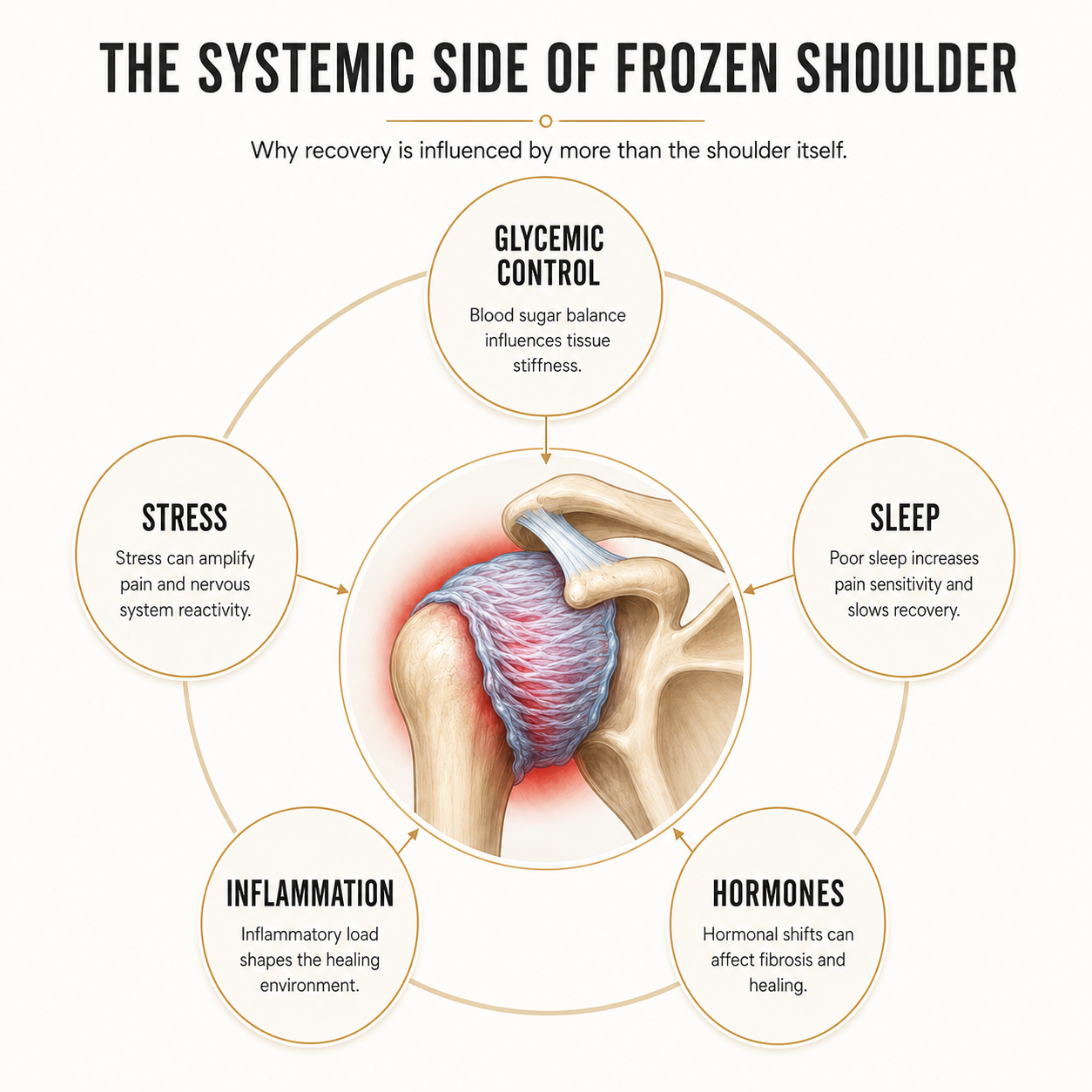
If frozen shoulder is genuinely an immunometabolic condition, then the metabolic and lifestyle context becomes a treatment target, not a footnote. This is the area where outcomes can shift meaningfully but where most rehabilitation programs go silent.
Glycemic control
If you have diabetes or pre-diabetic markers, addressing them is not optional. Glycation of capsular tissue appears to be a direct driver of stiffness, and the long-term outcome data in poorly-controlled diabetics is sobering.14
Anti-inflammatory eating patterns
Reducing ultra-processed foods, increasing omega-3 intake, supporting polyphenol-rich whole foods. None of these are silver bullets, but they shift the inflammatory milieu that the shoulder is trying to heal within.
Sleep
Inadequate sleep raises cortisol, central sensitization, and pain perception the next day. Frozen shoulder feeds insomnia and insomnia feeds frozen shoulder. Breaking that cycle matters.
Thyroid and hormonal review
If you are perimenopausal or postmenopausal, or if thyroid function has not been checked recently, this is worth raising with your physician. The estrogen-fibrosis link is an area of active research.15
Stress and nervous system regulation
Chronic sympathetic activation contributes to pain sensitization and shapes the metabolic environment. Breath work, daily meaningful movement, and time outside are not garnish, they are part of the treatment.
The Psychological Piece
Patients with frozen shoulder describe the experience in remarkably consistent ways across qualitative studies: a sense of being in "no man's land," dismissed, told to wait, given exercises that do not seem to help.
Two psychological factors emerge as the strongest predictors of slow recovery: kinesiophobia (fear of movement) and low pain self-efficacy (the belief that you cannot influence the outcome). Both are addressable. Both respond to clear explanation, validation, and progressive, meaningful exposure to movement.
We pay close attention to this part of care because the data tells us it matters.
When Surgery Enters the Conversation
For the small minority of patients who do not respond to a thorough conservative trial of three to six months, options include manipulation under anesthesia and arthroscopic capsular release. Both can be effective. Neither is first-line. Neither bypasses the need for staged rehabilitation afterward.
The shoulder still has to be loaded, taught, and integrated back into life, with or without a surgical step.
The ONE80 Approach to Frozen Shoulder

At ONE80 Health, frozen shoulder is approached as both a local capsular problem and a systemic condition. Our clinical team brings together chiropractic, osteopathy, soft tissue therapy, and acupuncture alongside a structured rehabilitation program matched to the stage of your condition.
Every patient receives a thorough assessment that identifies which stage you are in, screens for the systemic factors that may be contributing (metabolic, hormonal, inflammatory), and builds a clear plan for what the shoulder needs at the point you are at.
Treatment is built around the Four Pillars framework: Movement, Nutrition, Sleep, and Mindset. These are not peripheral lifestyle factors. They are physiological inputs that determine how fast tissue heals, how well the nervous system down-regulates pain, and whether your recovery holds.
Ready to get your shoulder properly assessed?
Same-day and next-day appointments available. We will identify the stage you are in, screen for the systemic factors that may be contributing, and build a clear plan for recovery.
Book an Assessment at ONE80References
All references link directly to PubMed or the publisher source. Tap a citation number in the article to jump here; tap the arrow beside a reference to return to where you were reading.
- Bunker TD, Anthony PP. The pathology of frozen shoulder. A Dupuytren-like disease. J Bone Joint Surg Br. 1995;77(5):677-83. pubmed.ncbi.nlm.nih.gov/7559688↩
- Wiley AM. Arthroscopic appearance of frozen shoulder. Arthroscopy. 1991;7(2):138-43. pubmed.ncbi.nlm.nih.gov/2069623↩
- Brindisino F, Mertens MG, Salamh P, et al. Beyond the capsule: an integrated perspective on the wide world of frozen shoulder. A collaborative viewpoint. Pain Manag. 2026;16(5):487-506. pubmed.ncbi.nlm.nih.gov/41787861↩
- Millar NL, Meakins A, Struyf F, et al. Frozen shoulder. Nat Rev Dis Primers. 2022;8(1):59. pubmed.ncbi.nlm.nih.gov/36075904↩
- Hamed-Hamed D, Rodriguez-Perez C, Pruimboom L, Navarro-Ledesma S. Influence of the metabolic and inflammatory profile in patients with frozen shoulder: systematic review and meta-analysis. BMC Musculoskelet Disord. 2025;26(1):475. pubmed.ncbi.nlm.nih.gov/40375116↩
- Mertens MGCAM, Meeus M, Ingwersen KG, Christiansen DH, Struyf F. The role of systemic and nervous system factors in patients with shoulder pain: a perspective review. Postgrad Med. 2025;137(7):566-577. pubmed.ncbi.nlm.nih.gov/41047816↩
- Li D, St Angelo JM, Taqi M. Adhesive capsulitis (frozen shoulder). StatPearls. 2025. pubmed.ncbi.nlm.nih.gov/40095380↩
- Wong CK, Levine WN, Deo K, et al. Natural history of frozen shoulder: fact or fiction? A systematic review. Physiotherapy. 2017;103(1):40-47. pubmed.ncbi.nlm.nih.gov/27641499↩
- Kim DH, Kim YS, Kim BS, et al. Is frozen shoulder completely resolved at 2 years after the onset of disease? J Orthop Sci. 2020;25(2):224-228. pubmed.ncbi.nlm.nih.gov/30952550↩
- Zhang HN, Wang TT, et al. Efficacy comparison between acupuncture and other modalities in the treatment of rotator cuff diseases: meta-analysis of RCTs. Am J Transl Res. 2024;16(2):599-616. pubmed.ncbi.nlm.nih.gov/38463603↩
- Liu S, Chen L, et al. Efficacy of manual therapy on shoulder pain and function in patients with rotator cuff injury: a systematic review and meta-analysis. Biomed Rep. 2024;20(6):89. pubmed.ncbi.nlm.nih.gov/38682089↩
- Kirker K, Masaracchio M, et al. Manual therapy and exercise for adhesive capsulitis: a systematic review with meta-analysis. J Man Manip Ther. 2023;31(5):311-327. pubmed.ncbi.nlm.nih.gov/36861780↩
- Hill JL, et al. Evidence for combining conservative treatments for adhesive capsulitis. Ochsner J. 2024;24(1). pmc.ncbi.nlm.nih.gov/articles/PMC10949050↩
- Abate M, Schiavone C, Pelotti P, Salini V. Limited joint mobility in diabetes and ageing: recent advances in pathogenesis and therapy. Int J Immunopathol Pharmacol. 2010;23(4):997-1003. pubmed.ncbi.nlm.nih.gov/21244749↩
- Wang Z, Li X, Liu X, et al. Mechanistic insights into the anti-fibrotic effects of estrogen via the PI3K-Akt pathway in frozen shoulder. J Steroid Biochem Mol Biol. 2025;249:106701. pubmed.ncbi.nlm.nih.gov/39947440↩