
Knee pain that actually gets better.
From runner's knee to osteoarthritis, most knee pain is a load and capacity problem. We settle the irritable knee, then rebuild what it can handle.
Book an assessment →The knee is rarely the whole story.
Knee pain is one of the most common reasons people come to see us, and one of the most misunderstood.
How the hip controls the leg, how the foot meets the ground, and how much load the knee has been asked to absorb all feed into it. We treat the knee as part of the chain, settle what is irritable, and rebuild the capacity that closes the gap between what you are doing and what your knee can currently handle.
Find your condition.
Each guide covers what it is, why it happens, and how we treat it. Start with the one that sounds like you, or book an assessment and we will sort it out together.
Patellofemoral Pain
Aching at the front of the knee, worse on stairs, hills, and after sitting. The most common running-related knee complaint we see.
Coming soonPatellar Tendinopathy
Sharp, localised pain at the bottom of the kneecap that warms up with activity and bites the day after. A loading problem, not an inflammation problem.
Coming soonIT Band Syndrome
Pain on the outside of the knee that shows up at a predictable point in a run. Driven by compression and hip control, not friction.
Coming soonKnee Osteoarthritis
Stiffness, ache, and a knee that protests after rest. A diagnosis of osteoarthritis is not a reason to stop moving, and not a straight line to surgery.
Coming soonMeniscus & Ligament
Whether a tear is traumatic or degenerate changes everything about how it should be treated. That distinction is the whole question.
Coming soonKnee pain is a load and capacity problem.
Pain shows up when what you are asking of the knee is more than the tissue can currently handle. The fix is not resting the knee into weakness. It is rebuilding what it can handle.
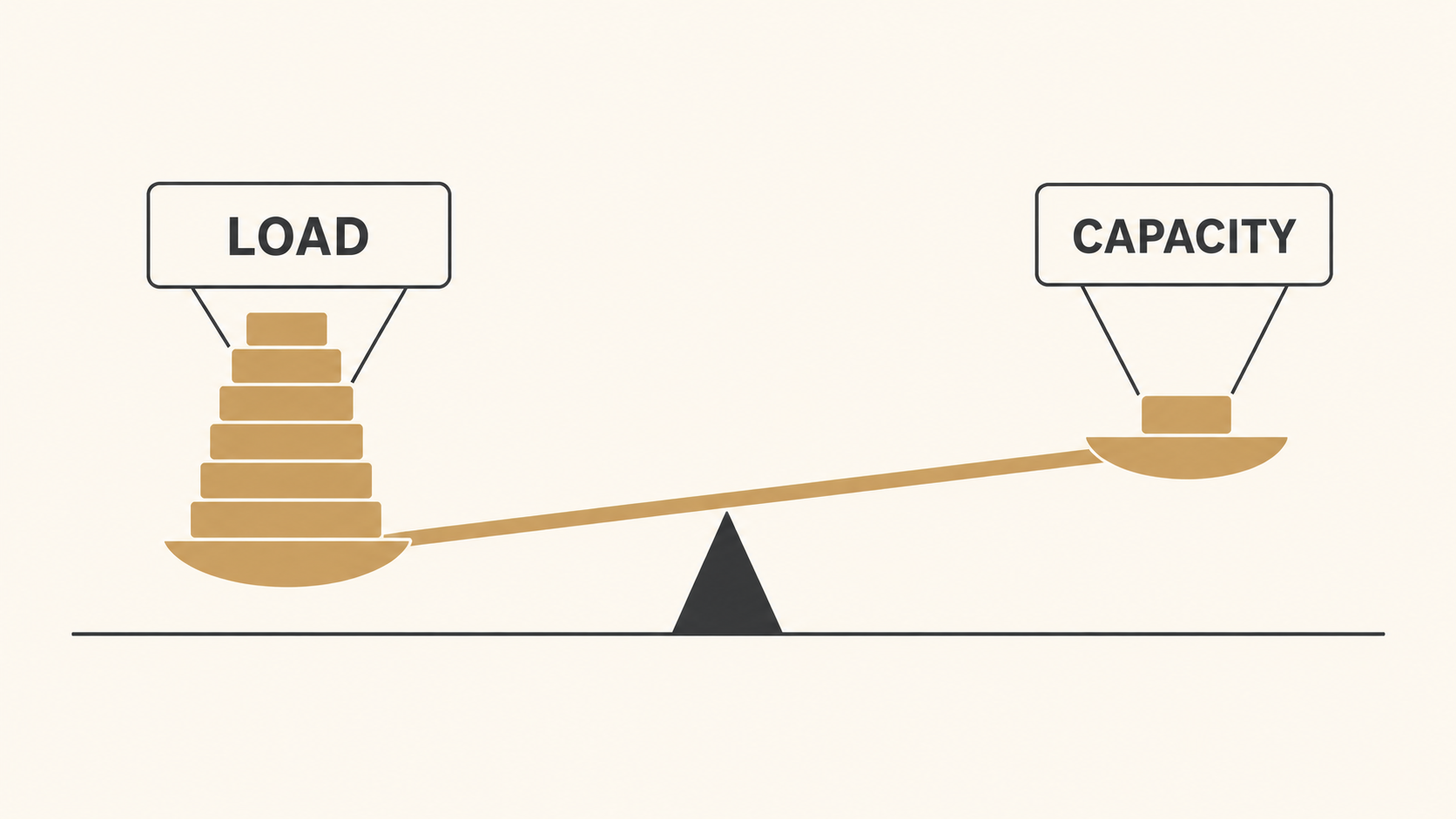
The load goes past the capacity
When the load through the knee is more than the tissue's current capacity, whether that tissue is the patellar tendon, the joint surface, or the structures around the kneecap, it becomes painful. Sometimes the load climbed. Sometimes the capacity quietly fell. Usually it is both, meeting in the middle.
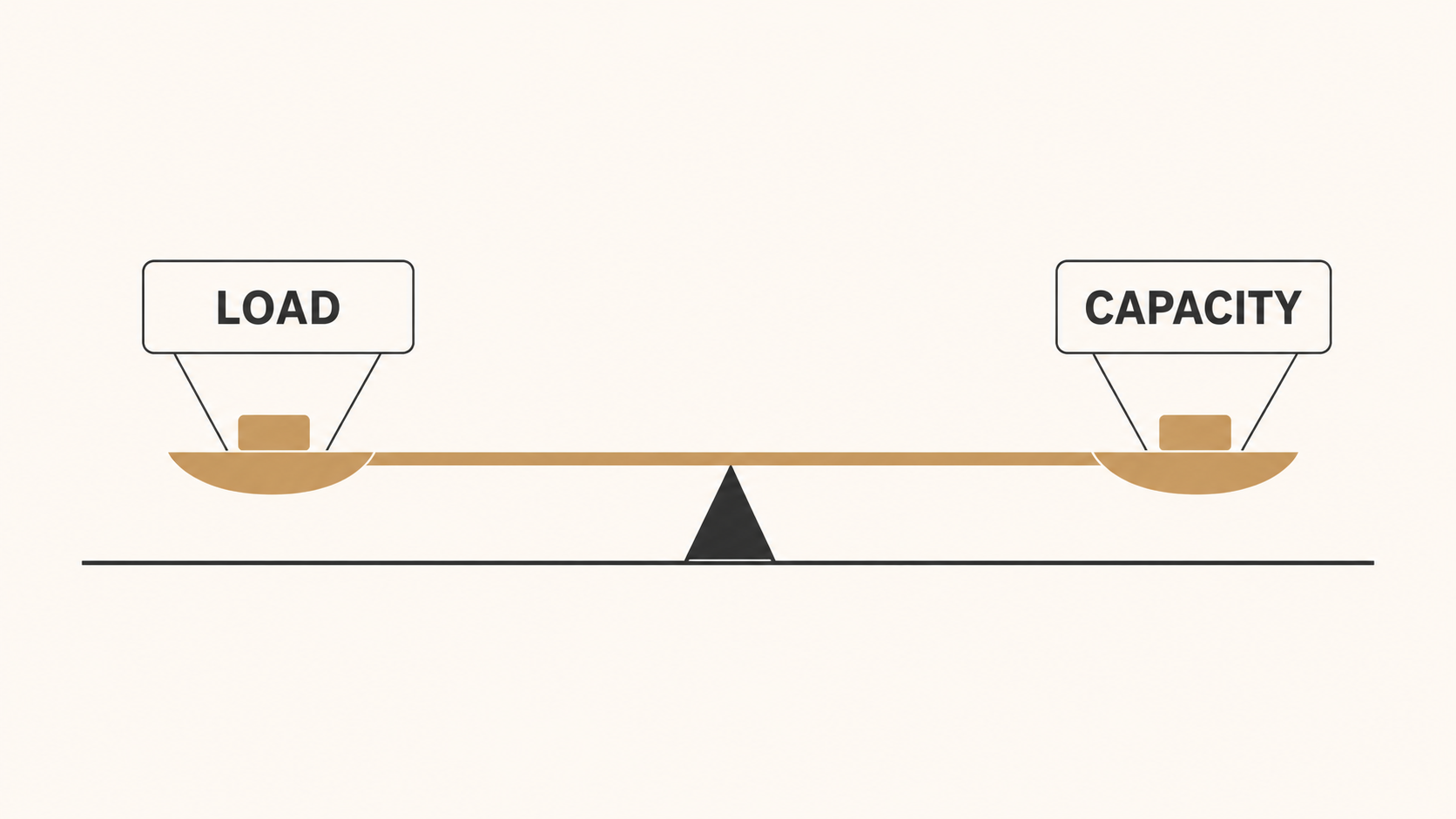
Rest lowers the load
You stop, and it settles. But rest lowers capacity too. The moment you return to what you were doing, the pain comes back, because the knee never got any stronger while you waited.
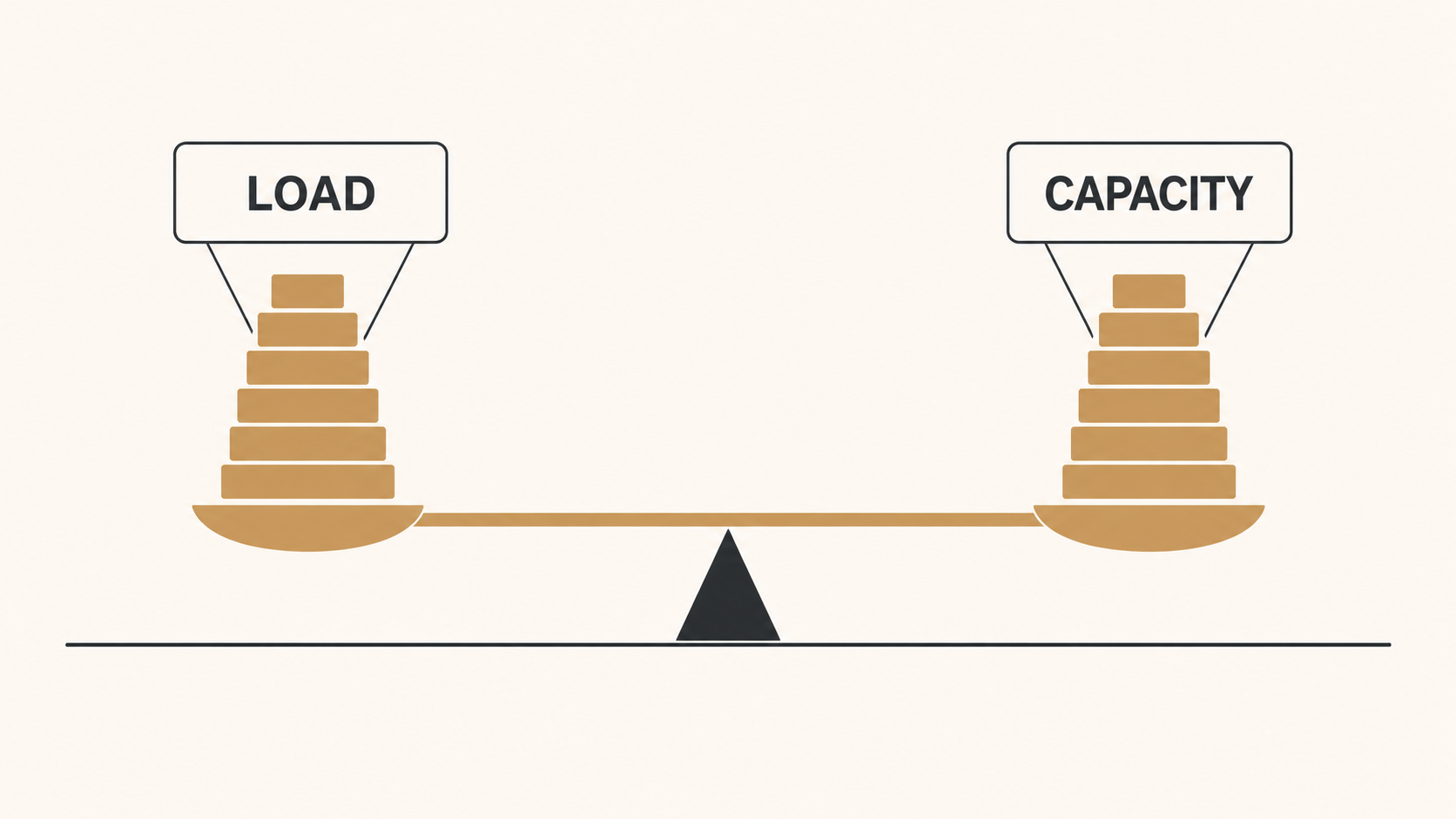
We build the capacity up
Instead of shrinking your life to fit the knee, we raise what the knee can tolerate. We calm the tissue enough to let you load it, then load it progressively until capacity sits comfortably above the demands you actually want to put on it. That is what makes the result hold.
Five stressors lower what your knee can handle.
Knee pain is rarely about one thing. Five kinds of stress stack up and quietly lower the knee's capacity, until an ordinary demand tips it over. We never force all five. Most cases are driven by one or two, and the skill is naming the ones that actually apply to you.
The Five Stressors
The Four Pillars
How we assess your knee.
Because the knee is rarely the whole story, the first visit looks beyond it. We take a detailed history, watch how you move and walk, and check the mobility, strength, and control of the knee, hip, ankle, and foot, with a neurological screen where it is warranted. The aim is to understand not just what hurts, but why the knee is being overloaded in the first place. That picture sets your entry point in the program of care.

Our care opens the door. Your loading walks through it.
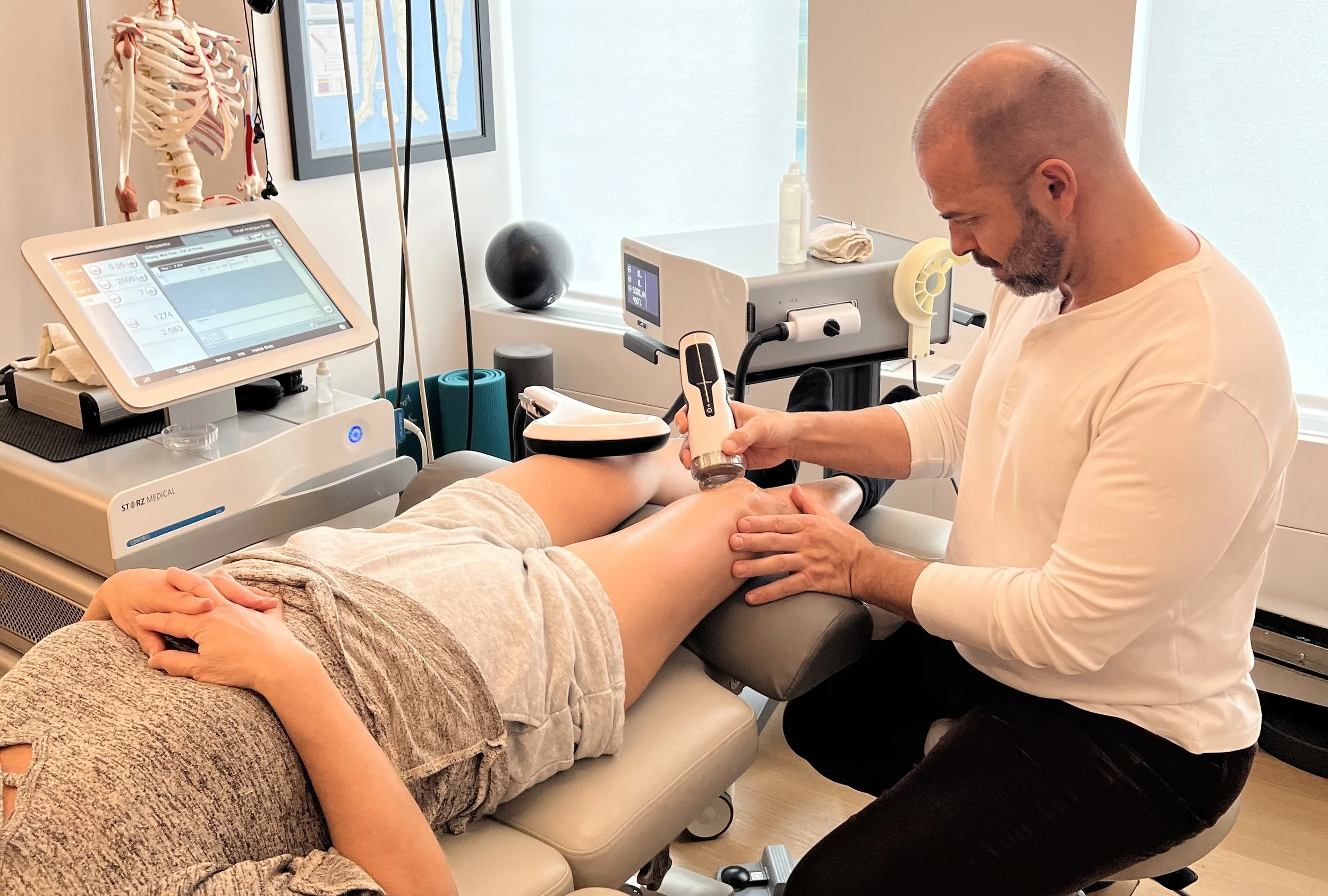
Treatment pairs progressive loading with the tools that support it. These settle the irritable knee and restart stalled repair, so the loading you do actually takes hold and builds lasting capacity.
Medical acupuncture and ART serve as adjuncts alongside the primary work.
For osteoarthritis and degenerative meniscal change, these non-invasive options paired with progressive loading are worth exploring before injection or surgery. The device work does its most valuable work early, when the knee is reactive, and steps back as your own loading takes over.
Every knee program runs on four phases.
You enter at the phase your presentation warrants, not automatically at the first one, and you move forward only when you have met the marks for the phase you are in. Nobody is rushed ahead before the knee is ready, and nobody is held back once it is.
Calm and Activate
Settle the irritable knee, restore pain-free basic movement. Load kept below the reactive threshold.
Load and Build
Progressive loading of the quads, hip, and knee to rebuild capacity and tolerance.
Strengthen and Integrate
Heavier, more complex loading into full-body and single-leg patterns.
Perform and Protect
Return to sport or full activity. Speed, power, and resilience to prevent relapse.
When it is worth getting assessed.
Not every knee needs a specialist, but some are worth looking at sooner rather than later. Consider booking an assessment if your knee pain has lasted beyond a few days, keeps returning despite rest, is getting in the way of work, training, or daily activity, or keeps coming back after you thought it had settled. Early clarity on what is driving it usually means a shorter road back.
See a doctor promptly if you have
- True locking or giving way of the knee.
- Significant unexplained swelling, redness, or heat.
- Pain after a significant twisting injury or trauma, or an inability to weight-bear.
- Focal bone pain, night pain, or pain that worsens with rest.
- Numbness, weakness, or pain radiating down the leg.
Load and capacity, the Five Stressors, the Four Pillars, and the four phases run through everything we treat.
Explore the ONE80 Method →Let's find out what is actually driving it.
We will identify what is driving your knee pain, name the stressors that actually apply to you, and build a clear plan around the pillars that move the needle. Same-day and next-day appointments are often available.
Book an assessment →